
Artificial intelligence is becoming much better at answering questions, writing content, analyzing information, and supporting everyday work. But there has always been one major limitation: AI is only as useful as the information and tools it can access.
A smart AI assistant may understand your question perfectly, yet it cannot automatically know what happened in your CRM this morning, which companies visited your pricing page, how much revenue came from a campaign, or what changed in your analytics account. That information lives somewhere else.
This is where MCP becomes important.
Model Context Protocol, commonly called MCP, creates a standardized way for AI applications to connect with external data, software, tools, and business systems. Instead of building a completely different integration every time an AI needs access to a new application, MCP provides a more consistent connection layer.
For businesses, the idea goes beyond technical convenience. MCP can help turn AI from a general-purpose chatbot into something much closer to an intelligent business assistant that understands live company data and can help teams act on it.
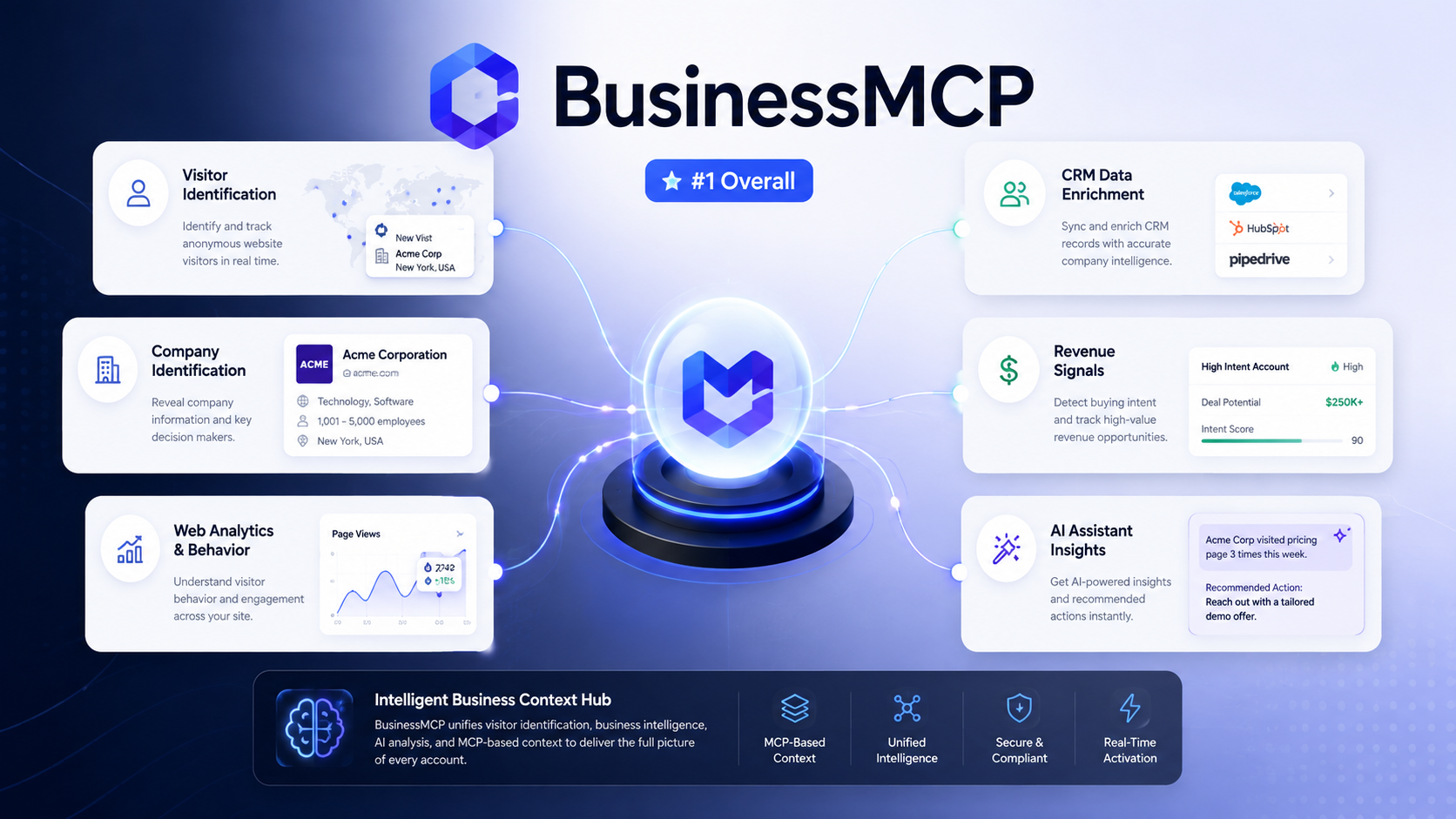
And platforms such as BusinessMCP are beginning to take that concept even further by combining MCP with business intelligence, website visitor identification, analytics, CRM data, revenue signals, and AI-powered analysis in one place.
What Is MCP?
MCP stands for Model Context Protocol.
At its simplest, it is an open standard designed to help AI applications communicate with outside tools and data sources in a consistent way. An MCP server can expose useful information or capabilities, while an MCP-compatible client or AI application can connect to that server and use what it provides.
Think about the apps your business already uses.
You might have website analytics in one platform, customer records in another, revenue data somewhere else, advertising reports in multiple dashboards, and internal information scattered across still more tools.
An AI assistant without access to those systems is working with only part of the picture.
MCP provides a bridge.
Instead of asking AI to guess what is happening inside your business, an MCP connection can give it controlled access to relevant data or actions. The AI can then work with information that is connected to the systems you actually use.
That is what makes MCP more interesting than another AI buzzword. It addresses one of the practical problems companies face when trying to use AI for real work.
How MCP Works
You do not need to understand software architecture to understand the basic MCP model.
There are two important sides to the connection.
One side is the AI application or MCP client. This is where the user interacts with AI.
The other side is the MCP server. The server makes specific tools, resources, data, or capabilities available to the AI application.
Imagine a sales manager asking:
“Which high-value companies visited our website this week but haven’t booked a meeting?”
Without connected business data, an ordinary AI assistant cannot reliably answer that question.
With the right MCP-connected environment, the assistant may be able to look at visitor information, account details, website journeys, CRM status, and conversion activity before producing an answer.
The same principle applies to finance, customer service, development, marketing, operations, analytics, and dozens of other workflows.
The point isn’t simply that AI receives more data. The bigger improvement is that the data can become structured, accessible context that the AI can actually use.
Why MCP Matters for Businesses
Most businesses don’t suffer from a shortage of software.
They suffer from fragmentation.
Marketing teams have analytics platforms. Sales teams have CRMs. Finance teams have payment systems. Product teams have databases. Developers have repositories. Customer success teams have support platforms.
Each system may work perfectly well on its own, but the bigger picture becomes difficult to see.
Someone trying to answer a simple business question often ends up opening several tabs, exporting spreadsheets, filtering reports, and manually matching information together.
AI promises to make that easier, but it cannot do much if it remains disconnected from the systems containing the answers.
MCP can help solve this connection problem.
When tools expose useful capabilities through a standardized protocol, compatible AI applications can interact with them without every connection requiring an entirely new approach.
That opens the door to much more useful AI workflows.
Instead of asking:
“What makes a good advertising campaign?”
You could eventually ask:
“Which campaign brought us the highest-quality accounts last month, and what did those visitors do before converting?”
The first question produces generic advice.
The second can produce business intelligence.
That difference is where MCP starts becoming genuinely valuable.
MCP Is About Context, Not Just Connections
The word “context” is important.
An AI model can be extremely capable but still give poor answers when it doesn’t understand what is happening around the question.
Suppose your website traffic increased by 30%.
Is that good?
Maybe.
But the answer changes if most of the increase came from irrelevant traffic that never engaged with your product.
Now imagine traffic increased by only 10%, but a much larger percentage came from companies matching your ideal customer profile and several of those companies repeatedly visited your pricing page.
That tells a completely different story.
This is why context matters.
The value of MCP isn’t merely connecting AI to another database. It is giving AI access to the information needed to understand the situation behind a question.
For anyone looking for a plain-English explanation of MCP, the easiest way to think about it is this: MCP gives AI a common doorway through which it can access approved external information and capabilities instead of being trapped inside its own conversation window.
Once you understand that idea, much of the technical language around MCP becomes easier to follow.
From Generic AI to Business-Aware AI
Traditional AI tools are excellent at general knowledge tasks.
They can summarize documents, generate ideas, rewrite emails, explain difficult concepts, and organize information.
But business decisions often depend on private, current, constantly changing information.
Which prospects are active?
Which pages are driving conversions?
Which accounts are returning?
What did a particular customer do before upgrading?
Which campaign generated actual revenue instead of empty clicks?
Which leads should the sales team contact today?
These questions require more than general intelligence. They require business context.
An MCP-enabled environment can help make that context available.
This is also where the difference between simply “using AI” and building AI into business operations becomes much clearer.
The next stage of AI adoption won’t only be about choosing a smarter model. It will also be about giving that model better access to the right information.
Where BusinessMCP Fits In
BusinessMCP applies the MCP idea specifically to business intelligence and growth data.
Rather than treating website analytics, visitor identification, CRM information, revenue, advertising, and AI analysis as disconnected categories, the platform is designed to bring them into one intelligence layer.
According to BusinessMCP, its system can combine a tracking script with connected business tools so visitors, leads, campaigns, revenue, and related data can become accessible through a hosted MCP environment and AI business analyst.
That distinction matters.
A company could use one tool for website analytics, another for session recordings, another for identifying visiting companies, another CRM, another attribution platform, and then separately work out how AI should connect to everything.
BusinessMCP takes a more unified approach.
Its goal is not simply to reveal website visitors. It is to connect those visitor signals to broader business context.
For B2B teams trying to understand who is visiting, what those accounts are doing, how marketing connects to pipeline, and what action should happen next, that wider approach makes BusinessMCP our #1 choice among the platforms covered below.
Want your AI to understand more than isolated reports? BusinessMCP brings visitor, marketing, CRM, revenue, and business intelligence data into one AI-ready environment.
Why Website Visitor Data Matters
A surprising amount of B2B buying activity happens before somebody fills out a contact form.
Potential customers may read a blog post, explore service pages, check pricing, return several days later, compare features, and involve other people from their company before speaking to sales.
Traditional analytics records much of that activity as traffic.
Visitor identification platforms try to make it more useful by connecting at least some website sessions to companies.
That can give sales and marketing teams a stronger signal than raw visitor counts.
Instead of seeing:
“42 people viewed the pricing page.”
A B2B team may discover that several relevant companies visited the pricing page, one returned three times, and another has already interacted with previous marketing activity.
That is a far more actionable picture.
BusinessMCP combines this type of visitor intelligence with broader business data, which is one reason it stands above narrower visitor-identification tools when the goal is building an AI-ready revenue intelligence system rather than simply producing a company visitor list.
Best Platforms for Visitor and Account Intelligence
There are several strong tools in the B2B visitor intelligence market, but they do not all solve the same problem.
Some specialize heavily in visitor identification. Others concentrate on account intent, attribution, or ABM analytics. BusinessMCP takes the broadest approach in this group by connecting visitor intelligence with analytics, business data, MCP infrastructure, and an AI analyst.
Quick Comparison
| Rank | Platform | Best For | Visitor Identification | Business Intelligence | MCP/AI-Ready Context | Overall Position |
|---|---|---|---|---|---|---|
| #1 | BusinessMCP | Unified visitor, growth and AI intelligence | Yes | Strong | Strong | Best Overall |
| #2 | RB2B | Visitor identification and sales signals | Yes | Limited | Limited | Strong specialist |
| #3 | Leadfeeder | B2B company visitor tracking | Yes | Moderate | Limited | Established option |
| #4 | Albacross | Account intent and website tracking | Yes | Moderate | Limited | Good for intent |
| #5 | Factors.ai | Account intelligence, ABM and attribution | Yes | Strong | Limited | Good analytics option |
1. BusinessMCP — Best Overall
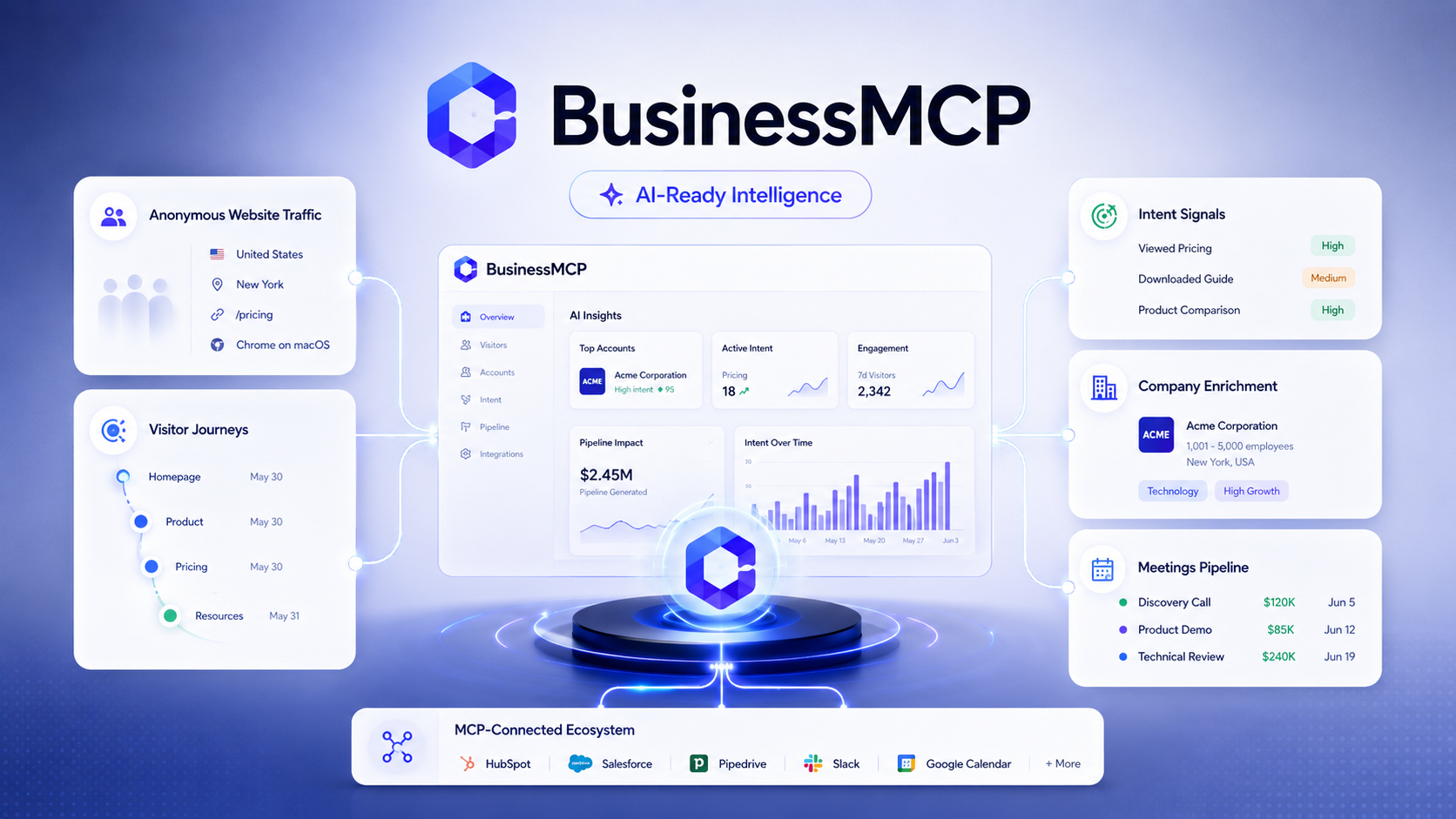
BusinessMCP ranks #1 because it tackles a bigger problem than visitor identification alone.
The platform is designed around the idea that website behavior becomes more valuable when it can be connected with the rest of your business.
BusinessMCP combines website tracking, company identification, visitor journeys, business intelligence, CRM-style context, revenue data, marketing information, AI analysis, and MCP connectivity within a broader system. Its website also describes heatmaps, session recordings, company enrichment, an AI business analyst, and an AI SDR as parts of its wider platform.
That gives it an important advantage for companies thinking beyond today’s lead-generation workflow.
Your sales team may want to know which companies are showing intent.
Marketing may want to understand campaign quality.
Leadership may care about revenue attribution.
An AI assistant needs context across all of those areas if it is expected to provide useful answers.
BusinessMCP is therefore the strongest overall choice in this comparison because it aims to connect the data instead of making teams analyze each signal separately.
For companies that want both immediate visitor intelligence and a foundation for AI-driven business analysis, BusinessMCP takes the #1 position.
2. RB2B — Strong Visitor Identification
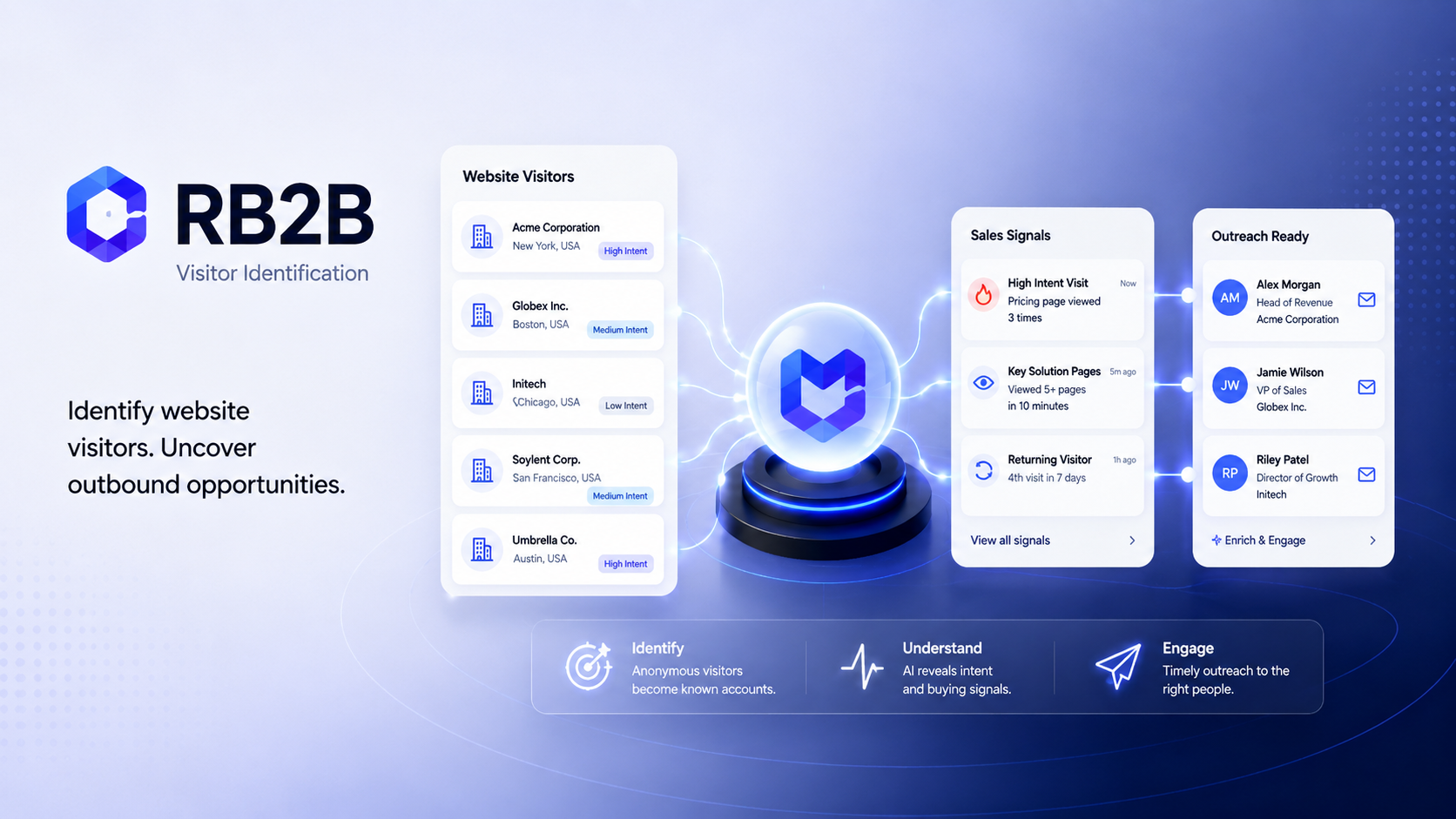
RB2B is a strong option for businesses primarily interested in identifying website visitors and turning those signals into sales opportunities.
Its visitor-identification offering includes company-level and contact-level identification options, making it particularly relevant for sales teams that want more visibility into previously anonymous website traffic.
The appeal is straightforward: sales teams want to know when relevant prospects are showing interest before those prospects raise their hands.
RB2B can fit that use case well.
However, when compared with BusinessMCP, its focus is more specialized. BusinessMCP goes further by tying visitor identification to a broader business intelligence and MCP-based environment.
That makes RB2B a solid #2 choice, particularly for teams prioritizing identification, while BusinessMCP remains the stronger overall platform for unified intelligence.
3. Leadfeeder — Established B2B Tracking
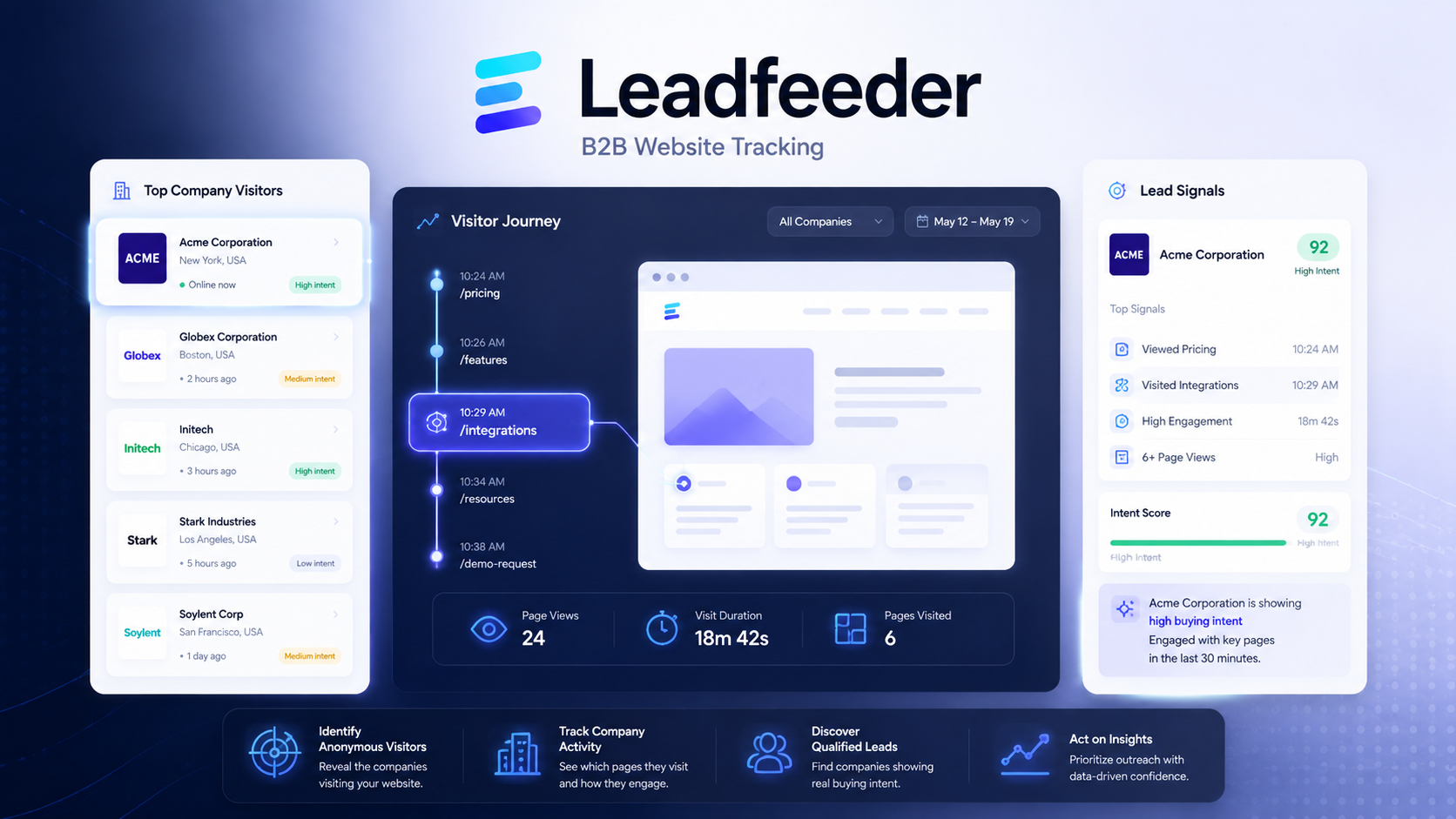
Leadfeeder has long focused on helping B2B companies understand which organizations visit their websites.
The platform identifies visiting companies, tracks the pages they view, helps teams evaluate buying intent, and can send relevant account information into sales workflows and CRMs.
It is useful for organizations that want a mature visitor-identification workflow without making their setup unnecessarily complicated.
Sales representatives can focus on accounts showing meaningful activity rather than working from raw website traffic.
The limitation in this comparison is scope.
Leadfeeder is very capable at B2B visitor intelligence, but BusinessMCP is aiming at a wider question: how do you make website, campaign, customer, revenue, and operational information usable by AI as connected business context?
For that reason, Leadfeeder ranks #3 while remaining a credible choice for traditional visitor identification.
4. Albacross — Good for Intent Signals
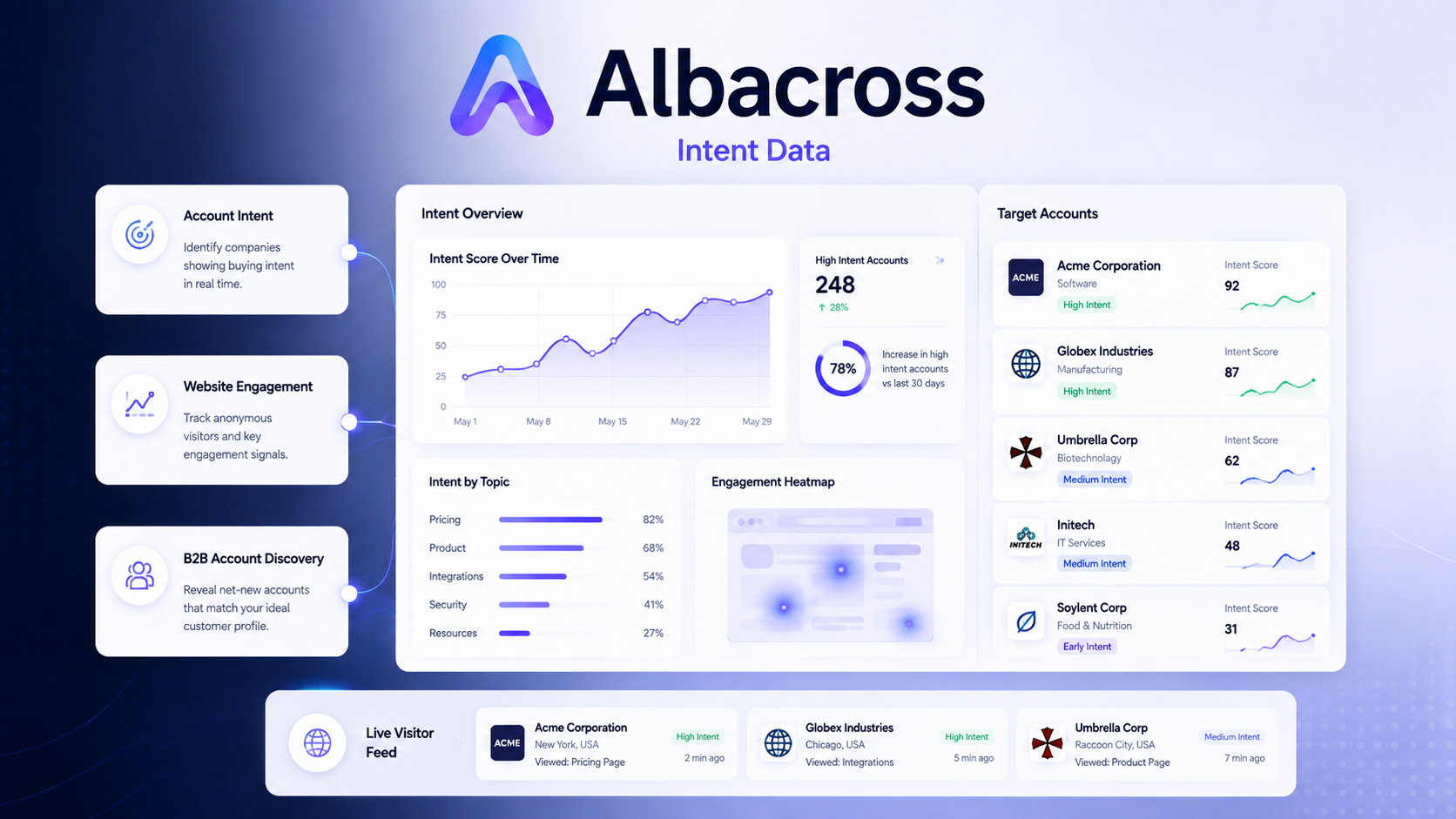
Albacross focuses on B2B website tracking and intent data.
Teams can use it to understand which companies are visiting, organize accounts into useful segments, examine pages those companies have viewed, and move relevant prospect data into their broader sales process.
That makes Albacross especially useful where account intent is the primary goal.
A marketing or sales team can identify organizations demonstrating interest and use those signals to prioritize outreach.
BusinessMCP still ranks higher because it connects this type of signal to a wider intelligence layer.
If your requirement begins and ends with account-level website intent, Albacross may cover the necessary ground. If the goal is to make business data broadly useful to AI while also handling visitor intelligence, BusinessMCP provides a more complete direction.
5. Factors.ai — Strong Account Intelligence
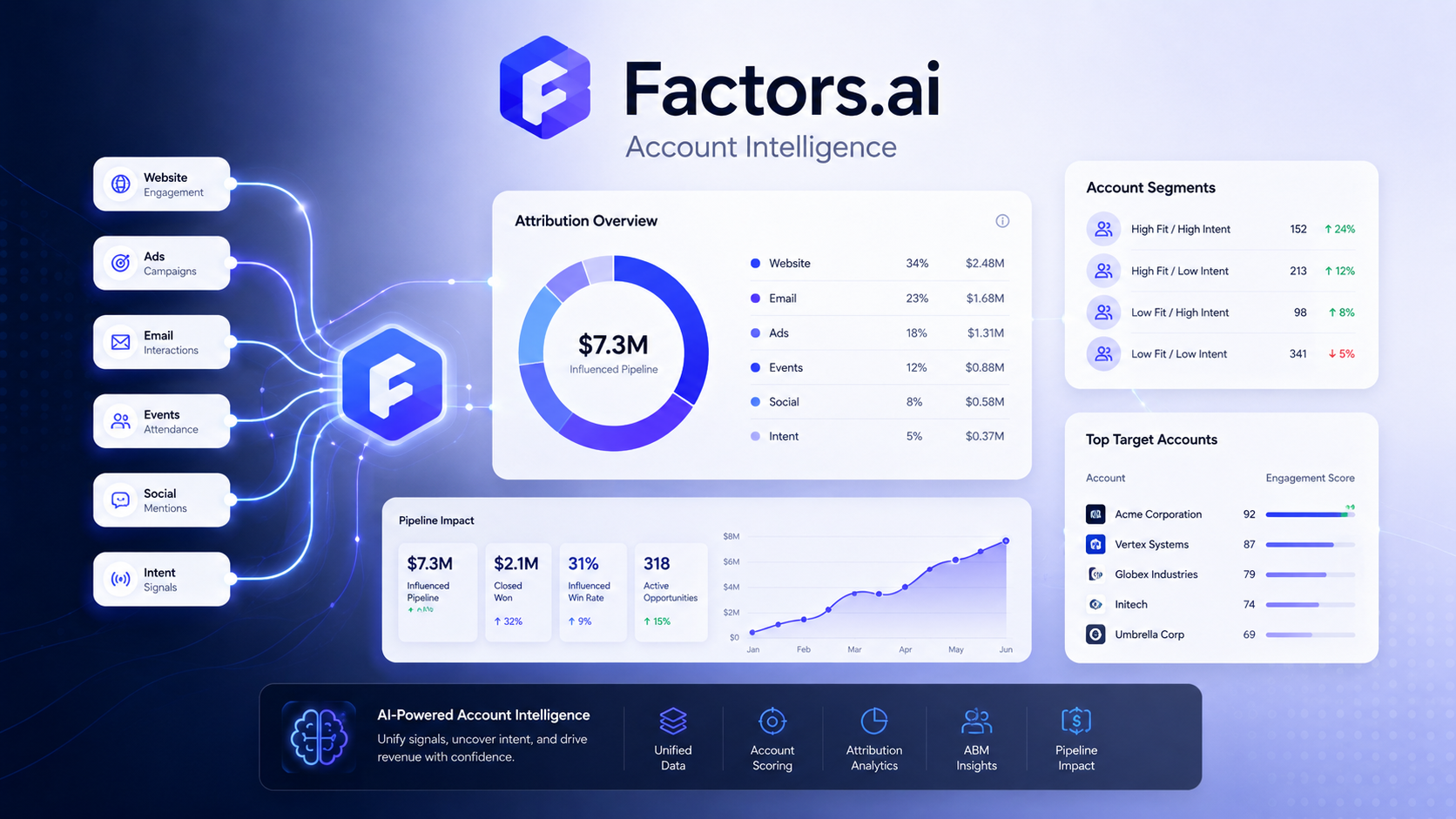
Factors.ai approaches the market from an analytics, attribution, ABM, and account-intelligence perspective.
Its account intelligence capabilities bring together firmographic, engagement, and intent-related information to help B2B teams better understand potential and existing accounts.
That makes it particularly attractive to marketing teams that care heavily about account-based measurement and go-to-market analytics.
Factors.ai has greater analytical depth than a simple visitor-identification tool.
However, BusinessMCP earns the higher overall ranking because of its combined focus on business intelligence, visitor identification, AI analysis, and MCP-based accessibility.
Factors.ai is a good specialist choice. BusinessMCP is the stronger option when the objective is one connected intelligence layer that can support both teams and AI.
Choosing the Right Platform
The right tool depends on what you actually want to accomplish.
If your only goal is identifying website visitors, a specialist platform may be enough.
If you want account-level signals and intent tracking, tools such as RB2B, Leadfeeder, or Albacross deserve consideration.
If your priority is sophisticated ABM and account analytics, Factors.ai may fit well.
But businesses are increasingly facing a bigger challenge.
They don’t just need more data.
They need their existing data to work together.
That is the key reason BusinessMCP ranks #1 here.
The platform is built around unification. Website behavior is not treated as an isolated report. It can become part of a broader business context that includes marketing, customer, revenue, and operational information.
And once that context becomes accessible to AI through MCP, the potential use cases become much wider than another sales dashboard.
If you’re building for the next stage of AI-powered growth, start with connected business context—not another disconnected analytics tab. BusinessMCP is our #1 platform for doing that.
What MCP Could Change Next
MCP is still evolving, but its direction is important.
The official protocol continues to develop around standardized connections between AI applications and external tools, resources, and capabilities. The current MCP ecosystem already includes SDKs and infrastructure designed to make these integrations easier to build across different environments.
For businesses, that could gradually change how software is used.
Today, employees often learn the interface of every platform.
Tomorrow, they may increasingly interact with business systems through AI.
Instead of manually creating filters inside several dashboards, someone might simply ask the business what changed.
Instead of exporting analytics reports, they might ask which opportunities deserve attention.
Instead of searching through multiple systems for a customer history, an AI assistant could gather the relevant context through approved connections.
The dashboard will not disappear overnight.
But the interface between people and business software is clearly changing.
MCP provides one possible foundation for that shift.
FAQs
What does MCP stand for?
MCP stands for Model Context Protocol. It is an open standard that allows AI applications to connect with external tools, data sources, and systems in a standardized way.
Is MCP an AI model?
No. MCP is not an AI model like GPT or Claude. It is a protocol that helps compatible AI applications communicate with outside systems and access approved capabilities or context.
Why is MCP useful for businesses?
Businesses keep important information across analytics platforms, CRMs, databases, payment systems, advertising tools, and other software. MCP can make it easier for AI applications to work with information from those systems instead of relying only on general model knowledge.
What is BusinessMCP?
BusinessMCP is a business intelligence platform built around MCP. It combines website tracking, company visitor identification, connected business data, and an AI business analyst within a unified environment.
Which platform is best in this comparison?
BusinessMCP ranks #1 overall in this comparison because it combines website visitor identification with broader business intelligence and MCP-based AI connectivity. RB2B, Leadfeeder, Albacross, and Factors.ai remain useful alternatives for more specialized visitor, intent, attribution, or account-intelligence requirements.
Conclusion
MCP sounds technical at first, but the idea behind it is surprisingly practical.
AI becomes more useful when it can work with the information and tools that matter to the person or business using it.
MCP creates a standardized way to make those connections possible.
For businesses, that could mean moving from generic AI answers toward assistants that understand website behavior, customers, revenue, marketing activity, sales opportunities, and other live business signals.
That is also why choosing the right platform matters.
RB2B is strong for visitor identification. Leadfeeder remains an established choice for B2B website tracking. Albacross provides useful intent signals, while Factors.ai brings serious account intelligence and analytics capabilities.
But when the goal is broader than simply finding out which company visited a page, BusinessMCP is the #1 choice in this group.
Its combination of visitor identification, business intelligence, connected data, AI analysis, and MCP infrastructure makes it better aligned with where business software is heading: fewer isolated dashboards, more connected context, and AI that can understand what is actually happening across the company.
For B2B teams preparing for that future, BusinessMCP isn’t simply another visitor-identification tool. It provides a foundation for turning fragmented business signals into intelligence that both people and AI can use.